
How to Maximize Ethanol Yield: The Role of Industrial Enzymes at Every Processing Stage
Discover how industrial enzymes maximize ethanol yield at every stage of production—from liquefaction and saccharification to fermentation. Learn best practices, feedstock optimization strategies, and enzyme selection for more efficient bioethanol and alcohol production.
ETHANOL PROCESSING
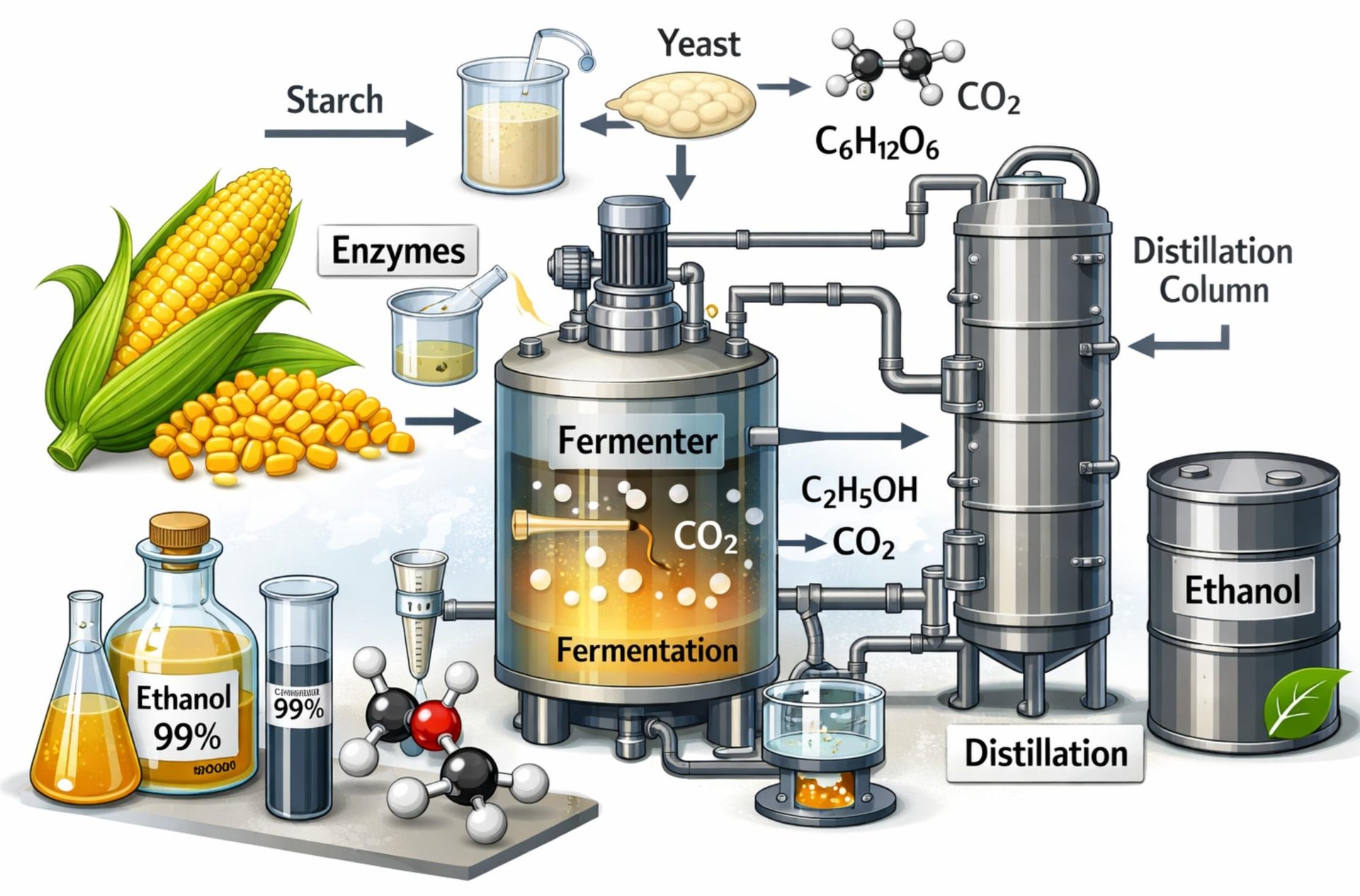
How to Maximize Ethanol Yield: The Role of Industrial Enzymes at Every Processing Stage
Ethanol production is one of the world's largest biotechnology industries, supplying fuel, beverage alcohol, pharmaceutical ingredients, and numerous fermentation-based products. Whether processing corn, wheat, cassava, barley, or other starch-rich feedstocks, every ethanol producer shares the same objective: maximizing ethanol yield while minimizing production costs.
Even a small improvement in starch conversion efficiency can translate into significant financial gains. For large-scale ethanol plants, increasing alcohol yield by just one percent may represent hundreds or even thousands of additional tons of ethanol annually, while simultaneously reducing raw material consumption and improving plant profitability.
Although modern ethanol production depends on sophisticated equipment and well-controlled fermentation systems, enzymes remain the driving force behind efficient starch conversion. From the initial liquefaction of starch to final fermentation, industrial enzymes determine how much of the available starch ultimately becomes ethanol.
Today, successful ethanol producers no longer rely on individual enzyme products. Instead, they implement integrated enzyme programs combining Heat-Stable Alpha-Amylase Solutions, Glucoamylase Solutions, and supporting enzymes such as Protease Solutions, Xylanase Solutions, and Cellulase & Hemicellulase Solutions to improve starch accessibility, optimize fermentation, and maximize alcohol yield.
This guide explores every stage of industrial ethanol production, explains the role of enzymes throughout the process, and outlines practical strategies for improving conversion efficiency, reducing process losses, and increasing overall plant performance.
Understanding the Ethanol Production Process
Although ethanol production methods vary depending on feedstock and plant design, the fundamental production chain remains largely consistent across the industry.
Industrial enzyme systems support nearly every biological stage of this process.
Ethanol Production Process Overview
Feedstock
↓
Milling
↓
Slurry Preparation
↓
Liquefaction
↓
Saccharification
↓
Fermentation
↓
Distillation
↓
Dehydration
↓
Fuel Ethanol or Beverage Alcohol
Each stage directly influences the next. Poor starch conversion during liquefaction cannot be fully corrected during saccharification, while inefficient saccharification limits fermentation performance regardless of yeast quality.
For this reason, ethanol production should be viewed as a fully integrated process rather than a collection of independent operations.
Where Enzymes Improve Ethanol Production
Industrial enzymes contribute to ethanol production in several important ways:
Increasing starch accessibility
Reducing mash viscosity
Maximizing glucose production
Improving yeast nutrition
Enhancing fermentation performance
Increasing alcohol yield
Reducing residual starch
Improving process consistency
The earlier these improvements occur in the production process, the greater their overall impact on final ethanol yield.
Stage 1 – Feedstock Selection and Preparation
The efficiency of ethanol production begins long before enzyme addition.
Feedstock quality determines the amount of fermentable starch available, influences enzyme performance, and ultimately affects production economics.
The most common industrial feedstocks include:
Corn
Wheat
Cassava
Barley
Rye
Sorghum
Other cereal grains
Each feedstock presents unique processing characteristics that require specific enzyme strategies.
Corn
Corn remains the dominant feedstock for fuel ethanol production in many regions due to its high starch content and predictable processing behavior.
Advantages include:
High starch concentration
Consistent raw material quality
Excellent ethanol yield
Well-established industrial processes
In most corn-based plants, the primary enzyme program consists of Heat-Stable Alpha-Amylase Solutions followed by Glucoamylase Solutions, with additional enzymes incorporated depending on process requirements.
Wheat
Wheat contains valuable starch but also higher levels of protein and non-starch polysaccharides than corn.
These additional components may:
Increase mash viscosity
Reduce starch accessibility
Complicate filtration
Influence fermentation
As a result, wheat processing frequently benefits from a broader enzyme program that includes:
Heat-Stable Alpha-Amylase
Glucoamylase
Xylanase
Protease
This integrated approach improves starch release while supporting downstream fermentation.
Cassava
Cassava has become an increasingly important feedstock for ethanol production in many parts of the world.
Its advantages include:
High starch content
Low protein concentration
High conversion potential
Good liquefaction characteristics
However, cassava also contains structural fibers that may restrict starch accessibility.
For this reason, Cellulase & Hemicellulase Solutions are often incorporated to improve starch recovery from plant tissues.
Barley and Other Cereal Grains
Barley, rye, and similar cereals contain higher concentrations of fiber and arabinoxylans than corn.
These components may increase mash viscosity and reduce starch extraction efficiency.
Supporting enzyme systems such as Xylanase Solutions and Protease Solutions often improve processing efficiency by reducing viscosity and enhancing starch accessibility.
Why Feedstock Quality Matters
Even the highest-performing enzyme cannot recover starch that is inaccessible because of poor raw material preparation.
Several feedstock characteristics directly influence ethanol yield:
Starch concentration
Particle size after milling
Moisture content
Protein concentration
Fiber content
Presence of non-starch polysaccharides
Careful feedstock evaluation allows producers to optimize enzyme selection before production begins.
Stage 2 – Liquefaction
Liquefaction is the first major enzymatic stage of ethanol production.
Its purpose is not to produce ethanol or even glucose.
Instead, liquefaction prepares starch for complete enzymatic hydrolysis during saccharification.
Following cooking and gelatinization, starch slurry becomes extremely viscous.
Without viscosity reduction:
Pumping becomes difficult.
Mixing efficiency decreases.
Heat transfer deteriorates.
Downstream enzymes cannot efficiently access starch molecules.
Liquefaction rapidly solves these problems.
The Role of Heat-Stable Alpha-Amylase
The principal enzyme used during liquefaction is Heat-Stable Alpha-Amylase.
This enzyme randomly hydrolyzes internal α-1,4 glycosidic bonds within starch molecules, producing soluble dextrins while dramatically reducing viscosity.
Rather than generating large quantities of glucose, alpha-amylase creates shorter carbohydrate chains that become ideal substrates for glucoamylase during the next processing stage.
Modern Heat-Stable Alpha-Amylase Solutions are specifically engineered for high-temperature industrial operation, providing reliable viscosity reduction and stable performance across a wide range of feedstocks.
Benefits of Efficient Liquefaction
Effective liquefaction provides numerous operational advantages.
These include:
Lower mash viscosity
Improved pumping efficiency
Better heat transfer
Increased starch accessibility
Improved downstream saccharification
More consistent fermentation
Higher ethanol yield
Because liquefaction establishes the conditions for every downstream operation, even small improvements at this stage can positively influence overall plant performance.
Common Liquefaction Challenges
Several factors may reduce liquefaction efficiency.
Common causes include:
Inadequate cooking
Incomplete starch gelatinization
Insufficient enzyme dosage
Poor mixing
Short residence time
Temperature fluctuations
Rather than increasing enzyme dosage immediately, operators should first verify that cooking conditions and process parameters are optimized.
Why Liquefaction Determines Downstream Performance
Many ethanol producers focus primarily on fermentation when alcohol yields decline.
However, the root cause often lies much earlier in the process.
Incomplete liquefaction produces larger dextrins that are more difficult for glucoamylase to hydrolyze.
As a result:
Glucose production decreases.
Fermentation slows.
Residual starch increases.
Final ethanol yield declines.
For this reason, efficient liquefaction should always be viewed as the foundation of high-yield ethanol production.
Stage 3 – Saccharification
Once liquefaction has reduced viscosity and converted starch into soluble dextrins, the process enters the saccharification stage.
This is where the majority of fermentable glucose is produced.
Unlike liquefaction, which focuses on preparing starch for hydrolysis, saccharification aims to maximize glucose production and ensure that as much of the available starch as possible becomes fermentable sugar.
The efficiency of this stage has a direct impact on:
Ethanol yield
Fermentation performance
Residual starch levels
Process economics
Plant productivity
Even small improvements in saccharification efficiency can significantly increase annual ethanol output.
The Role of Glucoamylase
The primary enzyme responsible for saccharification is Glucoamylase.
Unlike heat-stable alpha-amylase, glucoamylase is an exo-acting enzyme that removes glucose molecules sequentially from the ends of dextrin chains.
It hydrolyzes both:
α-1,4 glycosidic bonds
α-1,6 branch points
This allows nearly complete conversion of dextrins into fermentable glucose.
Industrial Glucoamylase Solutions are specifically designed to maintain high catalytic activity throughout extended saccharification and fermentation processes while delivering maximum glucose recovery.
Typical benefits include:
Higher glucose concentration
Lower residual dextrins
Improved ethanol yield
Better fermentation efficiency
Higher starch conversion
Reduced enzyme consumption
Improved process consistency
Typical Saccharification Conditions
Although conditions vary depending on the selected enzyme grade and plant configuration, saccharification typically operates under milder conditions than liquefaction.
Parameter Typical Industrial Range
Temperature 55–65°C*
pH Approximately 4.0–4.8*
Main Enzyme Glucoamylase
Typical DE95–98+
*Actual operating conditions depend on enzyme selection and production objectives.
Maintaining stable temperature and pH throughout this stage is essential for maximizing glucose production.
Why Complete Saccharification Matters
Incomplete saccharification leaves valuable starch unconverted.
Residual dextrins represent lost production potential because yeast cannot efficiently ferment large carbohydrate molecules.
Poor saccharification often results in:
Lower ethanol concentration
Increased residual sugars
Longer fermentation time
Reduced plant profitability
For this reason, optimizing saccharification is one of the most effective ways to improve overall ethanol production.
Simultaneous Saccharification and Fermentation (SSF)
Many modern ethanol facilities combine saccharification and fermentation into a single operation known as Simultaneous Saccharification and Fermentation (SSF).
Instead of producing glucose first and fermenting later, glucoamylase continuously releases glucose while yeast simultaneously converts it into ethanol.
This integrated process offers several important advantages.
Benefits of SSF
Higher ethanol productivity
Reduced glucose inhibition
Lower contamination risk
Shorter processing time
Lower capital investment
Improved overall process efficiency
Because glucose is consumed immediately after being produced, inhibition of glucoamylase is reduced, allowing the enzyme to operate more efficiently throughout fermentation.
Stage 4 – Fermentation
Fermentation is the stage where yeast converts glucose into ethanol and carbon dioxide.
Although enzymes no longer hydrolyze starch during this stage, enzyme performance earlier in the process has a profound effect on fermentation efficiency.
Healthy fermentation depends on several factors:
Adequate glucose availability
Proper yeast nutrition
Stable temperature
Appropriate pH
Sufficient Free Amino Nitrogen (FAN)
Effective mixing
When these conditions are maintained, yeast converts glucose rapidly and efficiently into ethanol.
Why Fermentation Performance Varies
Many producers assume poor fermentation is always caused by yeast performance.
In reality, fermentation problems frequently originate upstream.
Common causes include:
Incomplete liquefaction
Poor saccharification
Low glucose availability
Insufficient FAN
High mash viscosity
Poor process control
For this reason, fermentation should always be evaluated as part of the entire starch conversion process rather than as an isolated operation.
Supporting Enzyme Technologies
While alpha-amylase and glucoamylase perform the primary starch hydrolysis, supporting enzymes can significantly improve ethanol production by targeting non-starch components within the feedstock.
These enzymes enhance starch accessibility, improve yeast nutrition, reduce viscosity, and increase overall conversion efficiency.
Protease Solutions
Proteases play a particularly important role in ethanol production.
During grain processing, storage proteins may surround starch granules, reducing enzyme accessibility.
Proteases hydrolyze these proteins while simultaneously releasing peptides and amino acids that contribute to Free Amino Nitrogen (FAN)—an essential nutrient for yeast growth.
Benefits include:
Improved starch accessibility
Increased FAN production
Better yeast nutrition
Faster fermentation
Improved ethanol productivity
More consistent fermentation performance
Industrial Protease Solutions are especially valuable in wheat- and barley-based ethanol production, where protein content is significantly higher than in corn.
Why FAN Matters
Free Amino Nitrogen is one of the most important nutritional requirements for healthy yeast metabolism.
Adequate FAN supports:
Rapid yeast growth
Healthy cell reproduction
Faster sugar utilization
Higher alcohol productivity
Reduced fermentation stress
Insufficient FAN often leads to slower fermentation, incomplete sugar utilization, and reduced ethanol yield.
Xylanase Solutions
Many cereal grains contain large amounts of arabinoxylans and hemicellulosic materials.
These compounds absorb water, increase mash viscosity, and physically limit starch accessibility.
Industrial Xylanase Solutions hydrolyze these complex polysaccharides, providing several process benefits.
Advantages include:
Reduced mash viscosity
Improved starch release
Better filtration
Improved mixing
Enhanced fermentation performance
Higher overall ethanol yield
Xylanases are particularly beneficial when processing:
Wheat
Rye
Barley
Other cereal grains
Cellulase & Hemicellulase Solutions
Certain feedstocks contain cellulose-rich cell walls that physically trap starch granules.
Cellulase & Hemicellulase Solutions degrade these structural carbohydrates, allowing starch-converting enzymes to access additional substrate.
Potential benefits include:
Increased starch recovery
Improved sugar release
Better mash fluidity
Reduced residual solids
Improved raw material utilization
Increased ethanol production
These enzymes are particularly useful when processing:
Cassava
Whole grains
Agricultural residues
High-fiber feedstocks
Choosing the Right Enzyme Program
The optimal enzyme program depends on both the feedstock and the production objective.
Rather than selecting enzymes individually, most modern ethanol plants combine complementary enzyme technologies that work together throughout the process.
Every feedstock presents unique processing challenges. Factors such as starch concentration, protein content, fiber composition, and mash viscosity all influence enzyme performance and ethanol yield. Selecting the appropriate enzyme program for each raw material helps maximize starch conversion while improving overall production efficiency.
Corn
Corn has a high starch content and relatively predictable processing characteristics, making it one of the most efficient feedstocks for ethanol production.
Recommended enzyme program
Heat-Stable Alpha-Amylase Solutions
Glucoamylase Solutions
Wheat
Wheat contains higher levels of protein and arabinoxylans than corn, which can increase mash viscosity and reduce starch accessibility. An expanded enzyme program helps improve starch release and fermentation performance.
Recommended enzyme program
Heat-Stable Alpha-Amylase Solutions
Glucoamylase Solutions
Xylanase Solutions
Protease Solutions
Cassava
Cassava offers excellent starch content but contains structural fibers that may limit starch accessibility. Fiber-degrading enzymes help maximize starch recovery.
Recommended enzyme program
Heat-Stable Alpha-Amylase Solutions
Glucoamylase Solutions
Cellulase & Hemicellulase Solutions
Barley
Barley contains significant amounts of fiber and protein that can interfere with starch conversion and fermentation. Supplementary enzymes improve mash handling and increase overall ethanol yield.
Recommended enzyme program
Heat-Stable Alpha-Amylase Solutions
Glucoamylase Solutions
Xylanase Solutions
Protease Solutions
Rye
Rye is known for producing highly viscous mashes due to its elevated arabinoxylan content. Xylanases are particularly valuable for improving mash fluidity and starch accessibility.
Recommended enzyme program
Heat-Stable Alpha-Amylase Solutions
Glucoamylase Solutions
Xylanase Solutions
Matching the enzyme program to the raw material helps maximize starch conversion while improving overall production efficiency.
Factors That Influence Ethanol Yield
Regardless of feedstock, several operational variables consistently influence final alcohol production.
These include:
Temperature
Stable temperatures throughout liquefaction, saccharification, and fermentation help maintain both enzyme activity and yeast performance.
pH
Maintaining the correct pH throughout each processing stage is essential for maximizing enzyme efficiency and fermentation stability.
Residence Time
Both liquefaction and saccharification require sufficient reaction time to achieve complete starch conversion.
Short residence times often reduce ethanol yield.
Mixing Efficiency
Uniform mixing improves enzyme-substrate contact, promotes consistent hydrolysis, and supports healthy fermentation.
Dry Solids Concentration
Operating at higher dry solids concentrations can increase plant productivity but also increases viscosity, requiring careful optimization of enzyme dosage and process control.
Best Practices for Maximizing Ethanol Yield
Maximizing ethanol production requires more than selecting high-performance enzymes. Successful ethanol plants optimize every stage of the process—from feedstock preparation to fermentation—ensuring that starch is converted into ethanol as efficiently as possible.
The following best practices can help improve plant productivity, reduce production costs, and increase overall ethanol yield.
1. Start with High-Quality Feedstocks
Enzyme performance depends heavily on the quality of the incoming raw material.
Before production begins, evaluate:
Starch content
Moisture content
Particle size after milling
Protein concentration
Fiber content
Storage conditions
Consistent raw materials simplify process control and improve starch conversion efficiency.
2. Optimize Milling Efficiency
Particle size directly affects enzyme accessibility.
Coarse milling may leave starch trapped inside grain particles, while excessive milling increases energy consumption without providing significant processing benefits.
The objective is to produce a uniform particle size that maximizes starch exposure while maintaining efficient plant operation.
3. Ensure Complete Liquefaction
Liquefaction lays the foundation for the entire production process.
Incomplete liquefaction often results in:
High mash viscosity
Poor mixing
Lower glucose production
Reduced fermentation efficiency
Lower ethanol yield
Maintaining appropriate cooking conditions, residence time, and enzyme dosage is essential for producing a consistent dextrin profile before saccharification begins.
4. Maximize Saccharification Efficiency
Saccharification determines how much fermentable glucose becomes available for yeast.
To maximize glucose production:
Maintain stable temperature.
Control pH carefully.
Allow sufficient reaction time.
Verify glucoamylase activity.
Monitor starch conversion efficiency.
Even small improvements during saccharification can significantly increase annual ethanol production.
5. Support Healthy Fermentation
Healthy yeast converts glucose into ethanol more efficiently.
Successful fermentation depends on:
Adequate glucose availability
Proper yeast nutrition
Sufficient Free Amino Nitrogen (FAN)
Stable temperature
Appropriate pH
Effective agitation
Supporting enzymes such as Protease Solutions can improve FAN availability and contribute to more robust fermentation.
6. Match Enzyme Selection to the Feedstock
No single enzyme program is ideal for every raw material.
Selecting enzymes according to feedstock characteristics allows producers to improve starch accessibility while minimizing process limitations caused by proteins or structural fibers.
Integrated enzyme programs often deliver significantly better performance than individual enzyme products used alone.
7. Monitor the Entire Production Chain
Rather than evaluating individual process steps independently, operators should monitor the complete conversion pathway.
Routine monitoring should include:
Mash viscosity
Dextrose Equivalent (DE)
Glucose concentration
Fermentation rate
Residual starch
Alcohol concentration
Small deviations detected early can often prevent significant production losses.
A Practical Approach to Enzyme Selection
The optimal enzyme program depends on both the characteristics of the feedstock and the objectives of the production process. While Heat-Stable Alpha-Amylase Solutions and Glucoamylase Solutions form the foundation of most ethanol production processes, additional enzyme technologies can further improve conversion efficiency depending on the composition of the raw material.
Consider incorporating supporting enzymes under the following conditions:
If your feedstock has a high protein content
Proteins surrounding starch granules can limit enzyme accessibility and reduce fermentation efficiency. Adding Protease Solutions helps hydrolyze these proteins, improve starch availability, and increase Free Amino Nitrogen (FAN) for healthier yeast growth.
If your feedstock contains high levels of arabinoxylans
Feedstocks such as wheat, rye, and barley often contain significant amounts of arabinoxylans that increase mash viscosity and restrict starch extraction. Xylanase Solutions help reduce viscosity while improving starch accessibility and downstream processing.
If your feedstock is rich in structural fiber
Raw materials with higher cellulose and hemicellulose content may retain starch within plant cell walls. Cellulase & Hemicellulase Solutions break down these structural carbohydrates, releasing additional starch for conversion into fermentable sugars.
For most starch-rich feedstocks
A combination of Heat-Stable Alpha-Amylase Solutions for liquefaction and Glucoamylase Solutions for saccharification provides the foundation for efficient starch conversion. Supporting enzymes should then be selected according to the specific characteristics of the feedstock and the desired production objectives.
Troubleshooting Low Ethanol Yield
Even well-controlled ethanol plants occasionally experience reduced alcohol production. Identifying the root cause before adjusting enzyme dosage can significantly improve process efficiency while minimizing unnecessary operating costs.
Low Ethanol Concentration
Possible causes
Incomplete starch conversion
Poor saccharification
Insufficient glucose production
Fermentation inefficiency
Recommended actions
Verify starch conversion efficiency.
Review glucoamylase performance.
Monitor glucose concentration before fermentation.
Confirm fermentation conditions.
High Residual Starch
Possible causes
Incomplete liquefaction
Poor gelatinization
Insufficient residence time
Incorrect enzyme dosage
Recommended actions
Review cooking conditions.
Confirm complete gelatinization.
Optimize liquefaction before increasing glucoamylase dosage.
Evaluate Dextrose Equivalent (DE).
Slow Fermentation
Possible causes
Low glucose availability
Poor yeast nutrition
Low FAN
Temperature deviations
Recommended actions
Measure glucose concentration entering fermentation.
Evaluate protease supplementation.
Verify yeast viability.
Review fermentation temperature.
High Mash Viscosity
Possible causes
Incomplete liquefaction
High fiber content
Poor mixing
Recommended actions
Verify alpha-amylase dosage.
Improve cooking and mixing conditions.
Consider xylanase supplementation for cereal grains.
Poor Alcohol Recovery
Possible causes
Incomplete fermentation
Residual sugars
Process instability
Recommended actions
Review fermentation efficiency.
Evaluate residual glucose.
Verify upstream starch conversion.
Improve overall process monitoring.
Future Trends in Ethanol Production
Industrial ethanol production continues to evolve as producers seek higher productivity, lower operating costs, and more sustainable manufacturing practices.
Several trends are shaping the future of enzyme-assisted ethanol production.
High-Gravity Fermentation
Operating at higher dry solids concentrations allows producers to increase ethanol output while reducing water consumption and distillation costs.
This approach requires highly efficient enzyme systems capable of maintaining performance under more demanding processing conditions.
Advanced Multi-Enzyme Programs
Modern ethanol plants increasingly utilize integrated enzyme programs rather than relying solely on alpha-amylase and glucoamylase.
Supporting enzymes improve starch accessibility, reduce viscosity, and enhance fermentation efficiency, contributing to higher overall ethanol yields.
Digital Process Optimization
Advanced monitoring systems now enable real-time control of critical process parameters such as temperature, pH, viscosity, glucose concentration, and fermentation performance.
Combining automated process control with optimized enzyme programs helps improve consistency while reducing operating costs.
Sustainable Manufacturing
Improved enzyme technologies contribute to more sustainable ethanol production by:
Increasing raw material utilization
Reducing energy consumption
Lowering waste generation
Improving water efficiency
Supporting lower carbon emissions
As environmental and economic pressures continue to grow, enzyme optimization will remain a key driver of sustainable ethanol manufacturing.
Conclusion
Maximizing ethanol yield is not the result of optimizing a single production step. It requires a systematic approach that integrates feedstock selection, liquefaction, saccharification, fermentation, and overall process control into one coordinated production strategy.
Heat-stable alpha-amylase and glucoamylase remain the foundation of industrial starch conversion, while supporting enzymes such as xylanases, cellulases, hemicellulases, and proteases further improve starch accessibility, yeast nutrition, and fermentation efficiency.
Rather than viewing these enzymes as individual processing aids, successful ethanol producers implement integrated enzyme programs tailored to their feedstock and production objectives.
By combining optimized enzyme selection with robust process control, manufacturers can improve starch conversion efficiency, increase ethanol yield, reduce operating costs, and maximize the value of every ton of raw material processed.
Frequently Asked Questions (FAQ)
How can ethanol yield be increased?
Ethanol yield can be improved by optimizing liquefaction, saccharification, fermentation conditions, enzyme selection, and overall process control while minimizing starch losses throughout production.
Which enzymes are used in ethanol production?
The primary enzymes are heat-stable alpha-amylase for liquefaction and glucoamylase for saccharification. Depending on the feedstock, xylanases, cellulases, hemicellulases, and proteases may also improve production efficiency.
Why is glucoamylase important in ethanol production?
Glucoamylase converts dextrins into fermentable glucose, allowing yeast to produce ethanol efficiently while minimizing residual carbohydrates.
What is Simultaneous Saccharification and Fermentation (SSF)?
SSF combines saccharification and fermentation in a single process, allowing glucose released by glucoamylase to be consumed immediately by yeast, improving productivity and reducing contamination risks.
Why is Free Amino Nitrogen (FAN) important?
FAN provides essential nutrients for yeast growth and metabolism. Adequate FAN supports faster fermentation, healthier yeast populations, and higher ethanol productivity.
Can xylanase improve ethanol yield?
Yes. Xylanases reduce mash viscosity, improve starch accessibility, and enhance processing efficiency, particularly when processing wheat, rye, barley, and other cereal grains.
How do proteases support fermentation?
Proteases hydrolyze grain proteins and increase Free Amino Nitrogen (FAN), improving yeast nutrition and supporting faster, more efficient fermentation.
Which feedstock produces the highest ethanol yield?
Corn generally provides the highest and most consistent ethanol yield due to its high starch content. However, wheat, cassava, barley, and other feedstocks can also achieve excellent results when paired with appropriate enzyme programs and optimized process conditions.
Explore Related Solutions
Continue exploring enzyme technologies for industrial ethanol production:
Heat-Stable Alpha-Amylase Solutions
Glucoamylase Solutions
Protease Solutions
Xylanase Solutions
Cellulase & Hemicellulase Solutions
Ethanol & Alcohol Processing Solutions
